In: Streetworks
Over recent months we have run a series of online and face to seminars aimed at prolonged occupation charge risk mitigation for clients on the undertaker side of the street works ‘fence’. Delegate feedback has included the following comments:
“This is a must course for Street Works and Site Managers. The pitfalls are numerous and Tom delivers the main issues and how to avoid them. Highly recommend this course”
“Thanks for today, took some real pearls of wisdom that I’ve already spread round the office like wildfire!!”
“The course was very informative and explained really well to even those that had little to no experience with regards to the subject would understand clearly”
“Great insight into the legislation behind s74s and Tom Delivered this in a way that was engaging and thought provoking”
“delivery of seminar was very good and to the point, Tom is very knowledgeable and answered all questions throughout the seminar in good details that were easy to understand”
“Delivery was concise and gained the full attention and interaction of the audience throughout the seminar. I remained fully engaged. The opportunity to listen to the viewpoints of others were carefully considered and responded to appropriately. I felt included and particularly liked that there were people from different organisations, brought together by their mutual interest in NRSWA related activities.”
“Very in depth review of Section 74s and pinpointing key parts of the legislation to analyse.”
“I really enjoyed the way it was presented, very interactive involving the delegates in a positive manner”
“I thoroughly enjoyed the course and didn’t want to leave for my other meeting. I found that I learnt a great deal about the nuances of S74 from you. Thank you Tom”
Do get in contact if you are interested in us delivering compliance training to your team.
There are still some places on our forthcoming online seminars on challenging s.74 charges. Email info@tewsolicitors.co.uk for dates and details.
We’ll let delegate comments from previous training seminars do the ‘hard sell’…
“The ops teams training you did for us has contributed to a significant rise in site compliance and a massive drop in over runs.”
“Brilliant course”
“A very clear and precise presentation through a very difficult/ confusing subject”
25/05/2022
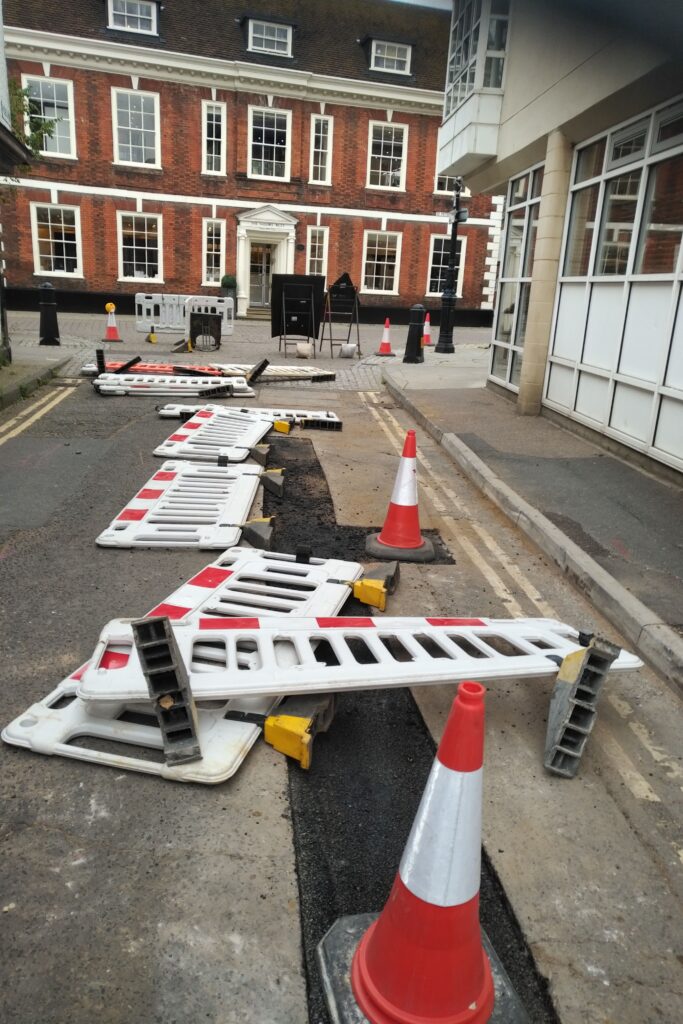
It’s all the contractor’s fault…
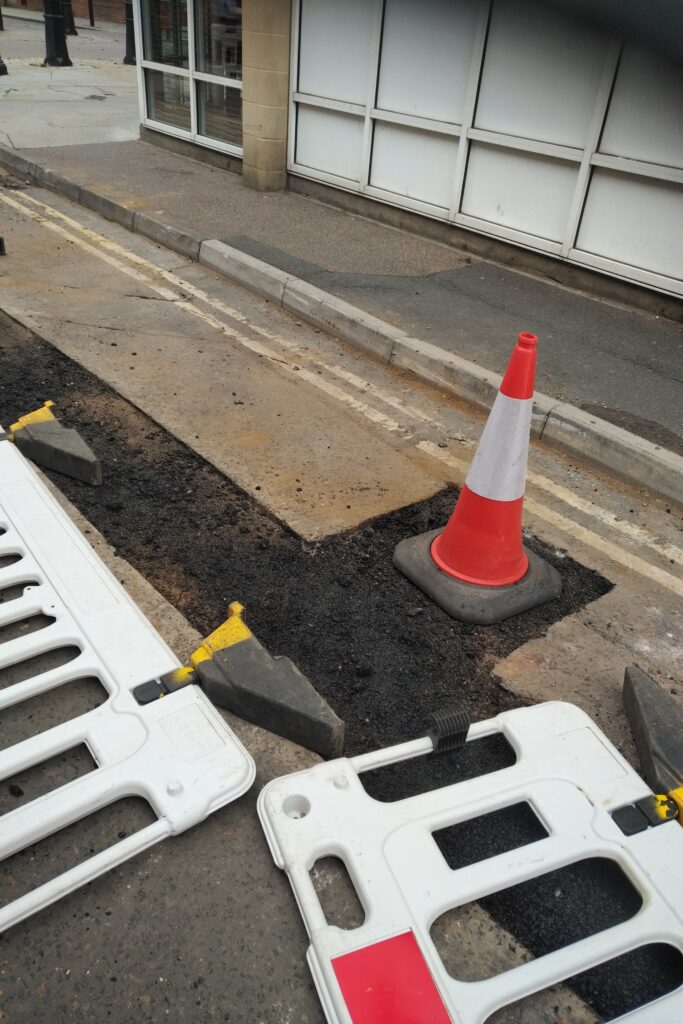
This is a sentiment we still hear from some undertaker clients when they find themselves in a New Roads and Street Works Act 1991 (“NRSWA”) related muddle and in need of our assistance.
The types of NRSWA muddle that explanation might be advanced in respect of might be:
- An unexpected claim from a street authority for s.74 prolonged occupation charges;
- A criminal prosecution under NRSWA and related legislation; or
- Fixed Penalty Notices (“FPNs”) for NRSWA and/or permit scheme non-compliances.
Whilst it may be an understandable sentiment from an undertaker, it is not one that always gets one anywhere.
Within this article what we want to do is:
- Consider where NRSWA liabilities sit;
- Address contractual ‘counter measures’ and their limitations; and
- Look at possible solutions.
Notwithstanding the title of this article, parts of it may be as applicable to undertakers with their own direct labour teams as those using contractors.
Where NRSWA liabilities sit
Although it may be the contractor’s acts and/or omissions that gave rise to the NRSWA muddle, legal liability for the outcome of any such muddle invariably sits firmly with the undertaker for NRSWA purposes. As a result it will be the undertaker and not the contractor:
- Being prosecuted and potentially convicted and fined for any criminal offence; and
- Against whom any civil claim might be brought by an authority or other party seeking to recover sums recoverable by it under NRSWA.
It is only in respect of the two criminal offences created by the Traffic Management Permit Scheme (England) Regulations 2007 that a permit scheme authority might consider raising a FPN or related criminal prosecution against a contractor in place of the undertaker itself. It has also been notable that authorities have generally proven reluctant to exercise their ability to pursue contractors for those offences, either by means of FPN or criminal prosecution, when they may have the undertaker ‘on the hook’ for them in any event.
Contractual counter-measures and their limitations
With liability to NRSWA criminal prosecution and/or civil claims sitting firmly on the shoulders of the undertaker, it makes sense for the undertaker to have express agreed contractual:
- warranties in place with its contractor requiring that the contractor undertake its works in compliance with NRSWA and other relevant legal requirements; and
- indemnities from the contractor against the loss/ damage/ costs and other financial penalties the undertaker might incur as a result of the contractor’s acts and/or omissions in breach of warranty.
At least with such contractual counter measures in place, the undertaker may have some prospect of holding a ‘wayward’ contractor to account and recovering its losses. Without such provisions in place holding a ‘wayward’ contractor to account may prove significantly more of a challenge.
Whilst strongly recommending that parties do have clear and express contractual warranties and indemnities in place, it is also the case that such warranties and indemnities:
- Will not guarantee that the contractor will never breach such warranties;
- Are unlikely to provide any comfort or defence against a NRSWA criminal prosecution against the undertaker (and the reputational damage that may ensue); and
- Will not ensure reimbursement to the undertaker of any charges, fines, or other penalties that it might be required to pay out to a third party as a result of any NRSWA criminal prosecution or civil claim resulting from the contractor’s breach of warranty.
Point 1 above is one that can occasionally take one in circles within a NRSWA context. This is best exemplified by the occasional response to the question “what were you doing to ensure NRSWA compliance?” being “we were paying the contractor to do that”. Viewed solely within a contractual context, that answer may make sense. Viewed within the context of NRSWA liabilities sitting solely on the undertaker’s shoulders, that answer may fall somewhat short. It is also an explanation that may fall even shorter on each occasion that the same contractor is the cause for the undertaker having another trip to a Magistrates’ Court for another alleged criminal breach of NRSWA. The Magistrates will want to know what you as an undertaker are doing to make sure the contractor isn’t getting things wrong, rather than hearing how the contractor may be repeatedly getting the same thing wrong (despite your paying them to get it right).
In respect of point 2 above, it is the undertaker’s name that may be press released by the prosecution and appear in the local “Bugle and Gazette” paper in the crime pages in the event of a NRSWA criminal conviction being received. Rarely would one ever see the contractor’s name in print in the same context.
As for point 3 above, this is particularly relevant where the amount of financial penalty imposed on the undertaker may be beyond the means of the contractor to pay out on any indemnity it has given. This has possibly become more of a risk with the increasing levels of fines the Courts have been imposing over recent years for NRSWA offences, especially when combined with the tight profit margins that some contracting sectors operate on. It is also the case that some contractors may legitimately challenge the basis of an indemnity claim for an alleged breach of warranty. It is therefore not guaranteed that an undertaker will always recover amounts it believes are due to it from contractors, even where contractual counter measures are in place.
When considering the issue of recovery under any indemnity, there is another feature of the utilities sector to consider. That is the ‘many linked’ length of the contractual chain that may exist between the undertaker and the contractor doing the actual work giving rise to the problem. It is common that there is a string of ‘back to back’ warranties and indemnities from the undertaker down to the furthest contractor. Those ‘back to back’ warranties and indemnities may however sometimes create a false sense of security for all parties by seemingly shifting ‘problems’ ever further away.
Whilst the undertaker will be the party paying out any NRSWA fines, charges or penalties, its ability to recover those amounts under any indemnities it has may be dictated by the ‘depth of pocket’ of those beneath it in the contractual chain. It is not unheard of for each ‘link’ in the contractual chain to ‘kick’ any indemnity claim down to the next ‘link’ in the chain. If at the bottom of the chain there is the proverbial ‘bloke with a wheelbarrow’, that liability may start working its way back up the contractual chain – particularly if said ‘bloke with a wheelbarrow’ proves not to have the means to pay up on any indemnity. Where the indemnity liability is likely to ‘stick’ on its way back up the chain is at the link in the contractual chain that does have the requisite depth of pocket to carry the liability. That could mean the ‘yo-yo’ indemnity claim, having gone all the way down the contractual claim, then works its way back up the chain, potentially leaving the undertaker again ‘holding the baby’.
What’s the solution?
So, having said what we have above, what’s the solution?
The contracting model is undoubtedly with us for the foreseeable, so we can forget any Elysian pipe dream of all works being undertaken by direct labour (good luck getting that model through a regulatory settlement or past an institutional investor…). It isn’t even as if direct labour would eliminate the problems in any event, as any undertaker with its own direct labour teams will confirm. The same NRSWA muddles are common to both models.
As alluded to above, one of the possible consequences of the contracting model is that it may provide a false sense to both undertakers and their contractors of NRSWA compliance responsibilities sitting ‘somewhere else’ in the contractual chain. The same risk may also however be present within an undertaker with direct labour where that direct labour sits within various different isolated ‘silos’. It is obviously the case that any part of the chain, whether it’s internal within the undertaker or external contractors, may trigger a problem that results in NRSWA liabilities being acquired by the undertaker. It is also the case that any link in the chain ‘dropping the ball’ they are responsible for can have knock on consequences elsewhere within the chain, causing other balls to be dropped and additional NRSWA liabilities to be acquired.
As local authorities come under increasing financial pressure, NRSWA related charges and penalties may (have?) become ever more a daily and increasing feature. Given that undertakers may have significant amounts of turnover and profits, it is possibly unsurprising that authorities might focus their attention on them. Whilst some NRSWA charges and penalties might be considered avoidable (such as: prosecutions; FPNs; and s.74 charges), others are starting to have the character of taxation – think permit fees, lane rental etc.
Although NRSWA criminal prosecutions may be relatively rare, particularly where imposing FPNs is more financially advantageous to authorities, when they do arise the consequences will almost certainly be greater than the sum of any fine that might be imposed by the Court upon conviction. Even on the financial side, the uncapping of fine levels for many NRSWA offences does mean even first offence fines can be a significant sum of money.
An undertaker should of course have appropriate contractual warranties and indemnities in place with contractors. However, don’t make the mistake of thinking they are the solution. They are certainly part of it but on their own won’t prevent problems from arising nor guarantee that the undertaker will be reimbursed the value of any loss/damage that might result from any contractor breaches.
With a significant proportion of the road system in England having originally been built by the Romans, the reputed advice from the Emperor Honorius to his distressed Romano-British subjects in 410 AD telling them to “See to your own defences” seems as apt for undertakers today pondering their potential NRSWA liabilities as it was to Romano-Britons (albeit the advice was given in a significantly different context!). If contractual warranties and indemnities are only part of the defences (and relatively passive elements at that) we advise that an undertaker take the following additional active measures to mitigate its potential NRSWA civil and criminal liabilities:
- Understand the range of NRSWA legal duties and obligations that apply to its works, irrespective of whether those works are undertaken by its own direct labour or by contractors on its behalf;
- Ensure that its own staff and its contractors’ staff understand the obligations under NRSWA that apply to the works that are being done for the Undertaker;
- Have an effective system of NRSWA compliance auditing and monitoring of its own staff and contractors’ works on its behalf; and
- Effectively monitor and assess the nature of NRSWA related charges and penalties being incurred by it (be they FPNS, s.74 charges, inspection charges, parking bay suspensions and (increasingly) lane rental, amongst others) whether incurred by direct labour or contractor’s and take steps where possible to reduce them.
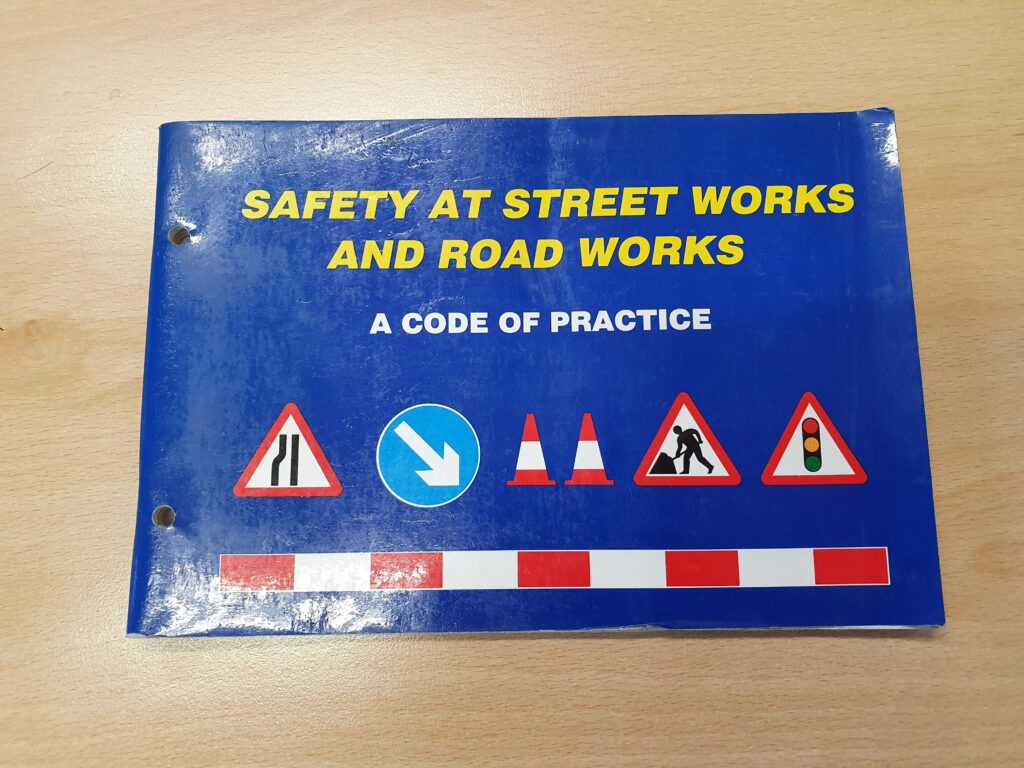
And for all those who believe they are already doing all of the above, here’s a picture that may take some people back a few years (20 or so years to be precise). This particular copy of that out-of-date Code of Practice was one ‘liberated’ by the writer from an attendee at a training session delivered a few years after the 3rd edition of that particular Code of Practice had come into force. Its owner had been unaware that he (and presumably every site he had set up for some years) was two editions of the Code of Practice out of date. He was a direct employee and not contractor staff for that particular undertaker…
If you want to know more about our work in this area and whether we maybe able to assist you contact us.

On the basis of prevention being better than an expensive cure, we thought it worth offering some tips to avoid a trip (real or virtual) to the Magistrates’ Court in 2021 on street works related prosecutions – with its potential adverse reputational and financial consequences.
Our tips are as follows:
- Ensure that your staff and contractor teams understand the requirements that have to be met and are equipped to meet them;
- Robustly audit and monitor compliance of works done by direct labour and contractors;
- Monitor defect reports and FPNs and address any substantive issues that are identified;
- Respond in a timely and effective fashion to any alleged non-compliance that might give rise to a prosecution; and
- Undertake root cause analysis on any problems identified and implement effective change to reduce the risk of re-occurrence.
Applying similar processes, the risks posed by FPNs, s.74 charges and defect inspections fees can also be reduced. Every FPN is a potential criminal prosecution.
If your business has the misfortune to find itself facing criminal prosecution or civil disputes under the New Roads and Street Works Act 1991 and related legislation, our team has extensive experience of advising and training undertakers and their contractors on street works compliance and defending related criminal prosecutions and civil disputes.
Do contact us if you think we can assist in reducing your legal risks from street works.
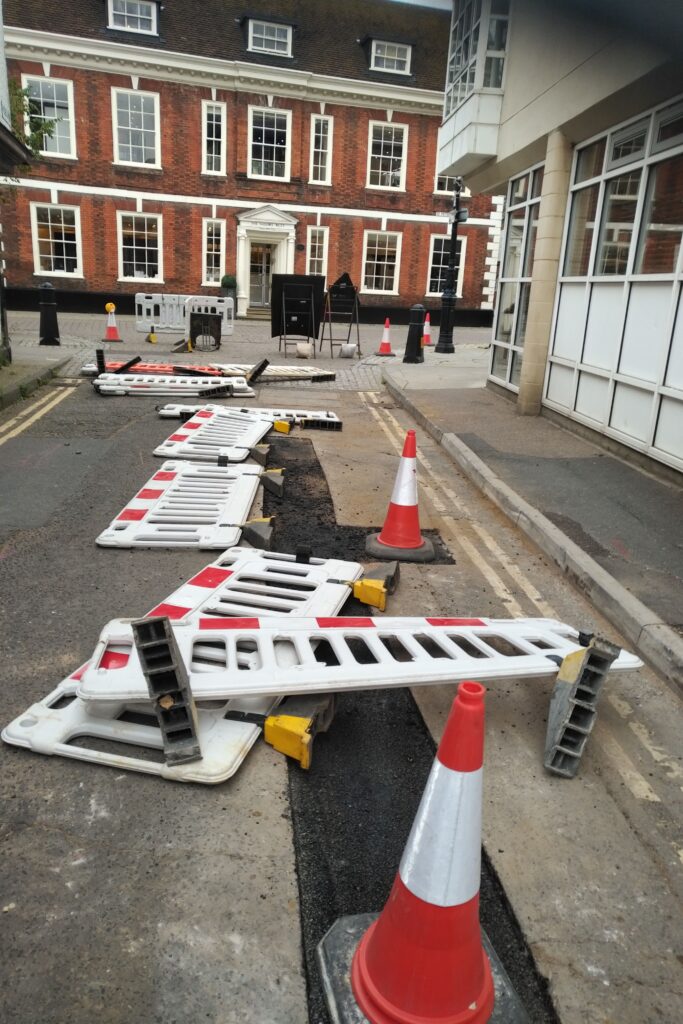
Whilst there have been very significant increases in street works compliance by utility companies and their contractors over the years, the financial and reputational risks posed to utility companies by certain street works related criminal offences has dramatically increased in recent years. This is as a result of the “uncapping” of level 5 offences brought about by the implementation on 12th March 2015 of s.85(1) of the Legal Aid, Sentencing and Punishment of Offenders Act 2012. For anyone wanting to know the detail, the implementing legislation was the Legal Aid, Sentencing and Punishment of Offenders Act 2012 (Commencement No. 11) Order 2015 (SI 2015/504).
The upshot of “uncapping” is that the previous maximum fine of £5,000 that applied to level 5 fines was removed and the level of fine that the Magistrates’ Court might impose is now effectively unlimited.
Before the “uncapping” of level 5 fines, a bad day in Court on a level 5 capped street works offence was unlikely to prove too financially painful – in the greater scheme of things. That is no longer the case. A bad day in Court on something that 5 years ago might have attracted a £3,000 fine might today see a utility company be sentenced to a considerably larger fine. Whilst it has taken a few years for fines to increase, fine ‘inflation’ has been significant in some parts of the country for even relatively minor non-compliances.
There are steps that an undertaker can take to mitigate the risks that its street work activities may pose. These include:
- Ensuring that all internal and contractor staff have an appropriate understanding of the legal obligations that street works legislation imposes;
- Self auditing of works being done by you and on your behalf and ensuring all non-compliances are promptly identified and rectified; and
- Responding promptly and effectively to any report of problems with a site or works.
Our team has extensive experience of advising undertakers on street works compliance and defending related criminal prosecutions.
Do contact us if you think we can assist in reducing your legal risks from street works.
02/01/2020
S. 50 street work licences

Growth in the multi utility provider sector has created a situation that the original drafters of the s.50 of the New Roads and Street Works Act 1991(“NRSWA”) possibly did not envisage.
This possible stretching of the original drafting does create potential issues for multi utility and other providers when seeking to install apparatus in the street where that apparatus is not being installed under an existing statutory right. It can also create issues where a multi utility provider does hold a statutory right to install one supply. The holding of a statutory right in respect of, say, gas as an Independent Gas Transporter will not, of itself, provide a statutory right to install water, electricity or telecoms apparatus.
Unlike a party with a statutory right to install apparatus in the street, a party wishing to install utility apparatus in the street who does not hold that right is left having to secure a s.50 licence from the street authority.
The most frequently encountered problem by parties seeking s.50 licences are the terms demanded by the street authority. The cause of this is that there is not a right to a s.50 licence. S.50(1) of NRSWA confers a discretion on a street authority as to whether it grants a s.50 licence by its use of the wording “The street authority may grant a licence…..” (our emphasis added).
That discretion is not an absolute one. Like all authority decision making, the discretion must be exercised reasonably. Any unreasonable exercise of the discretion by a street authority may leave the authority open to Judicial Review.
We advise multi utility providers on s.50 licence issues. We also challenge authority decision making processes where that is the appropriate course of action.
Contact us if you would like to discuss how we might assist you in respect of s.50 licences.

Being as keen on bacon sarnies as the next person and also seeing the real benefit of seeking to resolve disputes at an early stage, we take no issue with sorting out disputes over a bacon sarnie. Likewise, if your tastes run to chocolate biscuits with settlement discussions, we’re still completely on side. We’ll add the dull (but necessary) caveat about gifts and hospitality policies being complied with in terms of who is giving/receiving what.
One thing we are less certain of is whether all such discussions set off on the firmest of footings – particularly in respect of the legitimacy of the charges being discussed.
It’s obviously a great result for the paying party if they manage to successfully negotiate a claim down to a fraction of its original value. If however there was no legitimate charge there in the first place but you have agreed to paying 10% of the claimed charge, it may look less of a deal.
Placed in the context of low margins in the sector and those margins potentially getting smaller the further down the contractual chain one goes, a £10,000 payout on a s.74 charge could seriously dent the financial viability of the ultimate paying party. It’s obviously a great result if the charge is legitimately payable but has been successfully negotiated down. It’s a less great result if that charge should never have been accepted in the first place – even if it was successfully negotiated down.
Bearing in mind the significant sums that might fall to be decided over the bacon sarnies, we think there is real merit to going through all the individual charges with the proverbial fine tooth comb. If a proportion of them can be booted into touch before the bacon sarnies invite gets sent or the choccie biscuits bought, the base line for settlement discussions might significantly change.
From our own experience of advising on prolonged occupation charges, one of the key issues is the timely collation of factual information about the job in question relevant to how and why a job may have taken the time that it did. Collating that information as the job progresses so that it is all immediately accessible 12 months later when people are actually looking seriously at the charge makes things far easier than for the person charged with dealing with the dispute having to try to piece together what went on and why. Having all that information to hand may make the difference between nothing being paid out and several thousand being paid.
That a street authority may want you to pay them several thousand pounds for something they perceive to be a prolonged occupation meriting a charge, doesn’t necessarily mean that you owe them anything. Starting off with all of the relevant information to hand will provide considerably greater certainty of what sums may be owed and what a deal looks like.
Knowing that one has all relevant information before going into a meeting with the street authority will enable the person meant to be cutting the deal to concentrate on the key question for the meeting.
And, as we all know, that key question is whether to opt for brown sauce or ketchup.
We advise various energy and utility companies on the validity of s.74 prolonged occupation charges and challenges to such charges.
Contact us if we can assist you with any prolonged occupation charge issues you are encountering.